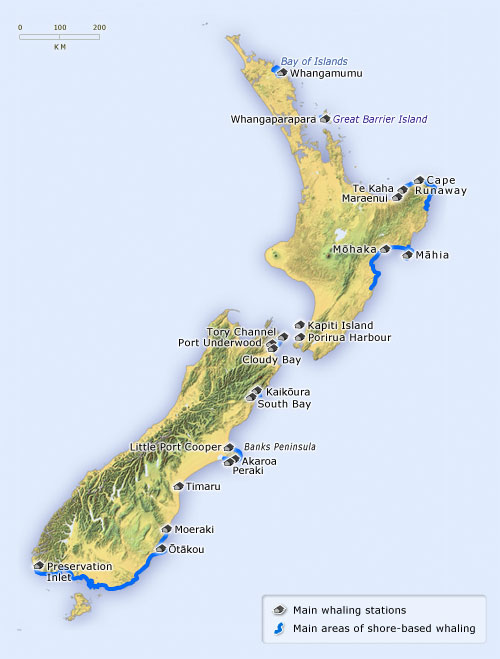
Different station counts
The six-station 1839 Kāpiti–Mana map and descriptions of five Kāpiti Island sites use different geographic scope; do not merge counts or infer direct contradiction.
The historical record
Historical accounts give different totals for Kāpiti whaling stations because they describe different years and geographical areas. Dieffenbach’s six stations and 23 boats refer to the Kāpiti–Mana district in 1839; Wakefield counted two stations in 1844 and again in 1847.
Archaeological surveys, by contrast, identify locations occupied at various times, including Long Point, Tokomapuna, Motungarara, Tahoramaurea and sites on the mainland and Mana Island. A map of all known locations therefore need not equal the number operating in one season.
Prickett’s station-by-station study is especially useful because it separates physical remains, contemporary testimony and the dates for which whaling activity can be documented.
Historical source: Nigel Prickett, The Archaeology of New Zealand Shore Whaling (2002), Kāpiti chapter, pp. 83–97; drawing on Dieffenbach, Wakefield, contemporary station records and archaeological surveys.
Why historical station totals differ
Station counts depend on the date, geographic boundary and definition used. Prickett’s synthesis reports six stations operating 23 boats in the Kāpiti and Mana region in 1839, producing 466 tuns of black oil excluding tonguers’ oil. That figure comes from Dieffenbach’s contemporary account and should not be confused with the number of known archaeological sites across all periods.
For 1844, Prickett cites seven boats at two stations; by 1847 he cites two stations with three boats producing 29 tuns of oil. These are snapshots of a changing industry, not competing counts for a single year.
Prickett also identifies a succession of leading stations: Tokomapuna in 1839, Long Point in 1841 and Waiorua thereafter. The shift helps explain why a map of every documented whaling location contains more places than the number operating in any one season.
Source: Nigel Prickett, The Archaeology of New Zealand Shore Whaling (2002), chapter 9, pp. 83–96; see the relevant station section and its cited contemporary records. Interpretations are attributed above.
Reading different returns together
The apparently different station counts belong to different years and sometimes different geographical groupings. Prickett juxtaposes six stations in 1839 with two in 1844 and two in 1847. Comparing the returns is evidence of changing recorded activity, not evidence that every individual station operated continuously between those dates.
Source: Nigel Prickett, “The Archaeology of New Zealand Shore Whaling” (2002), pp. 83–97.
Explore connected books