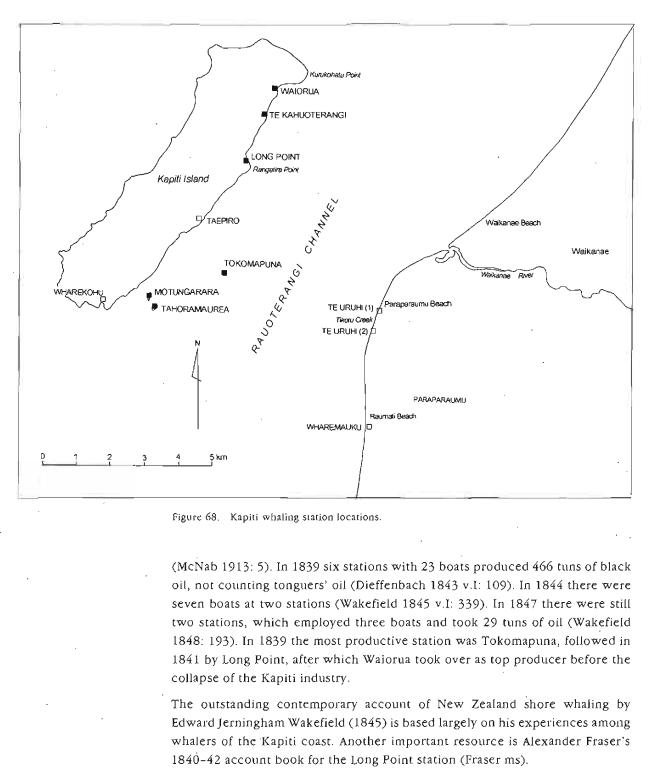
Stations and operators, scholarly interpretation
The article identifies William Mayhew with Tahoramaurea, Captain Horse Lewis with Motungarara, and Tommy Evans with Tokomapuna; says up to three mainland stations may have operated, but lacks firm evidence of mainland operations in 1839–40.
The historical record
Stations and operators, scholarly interpretation — That Glorious Stinking Stuff…, Journal of New Zealand Studies — The article identifies William Mayhew with Tahoramaurea, Captain Horse Lewis with Motungarara, and Tommy Evans with Tokomapuna; says up to three mainland stations may have operated, but lacks firm evidence of mainland operations in 1839–40.
Production and the movement between stations
Prickett’s account makes the Kāpiti–Mana industry a story of changing places rather than a static group of stations. Tokomapuna was the leading producer in 1839; Long Point led in 1841; Waiorua later became the principal Kāpiti station before the regional industry declined.
Fraser’s 1840–42 account book is especially valuable because it names categories of workers and records payments, supplies, equipment and freight to and from Sydney. It suggests how an enterprise could change rapidly when experienced headsmen and boat crews moved between stations.
The movement of Tommy or Thomas Evans from Tokomapuna to Long Point is a reasoned suggestion in Prickett’s account. The proposed transfer of Robert “Jellit” and experienced workers to Waiorua is likewise interpretive.
Source: Nigel Prickett, The Archaeology of New Zealand Shore Whaling (2002), chapter 9, pp. 83–96; see the relevant station section and its cited contemporary records. Interpretations are attributed above.
Names behind the station lists
Whaling history becomes more tangible when operators can be associated with particular landing places. The scholarly accounts connect William Mayhew with Tahoramaurea, Captain ‘Horse’ Lewis with Motungarara, and Thomas or ‘Tommy’ Evans with Tokomapuna. These associations also show the difficulty of working with changing spellings, nicknames and fragmentary documentary records.
A coast of different kinds of evidence
At Tahoramaurea, Prickett describes stone remains associated with the station and notes that Te Rauparaha lived on the northern part of the island in 1839 while Mayhew’s two-boat station was on the south. On Motungarara, stone whalers’ huts were described by Dieffenbach in December 1839. These material traces and eyewitness observations help locate activity that a shipping list alone could not explain. Source: Prickett (2002), pp.83–97.
Explore connected books