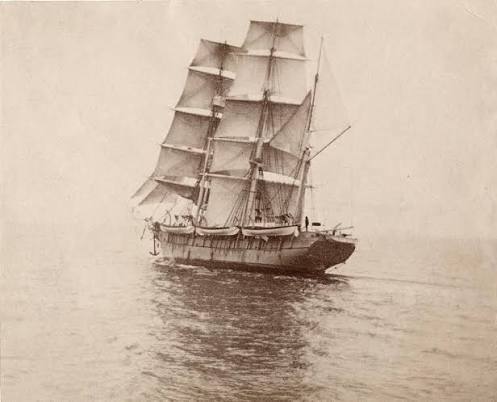
Four vessels at Long Point and the loss of John Dunscombe
In a June 1840 published account of a coastal journey, Edward Jerningham Wakefield describes the barques Justine and William Wallace and the schooners Susannah Ann and John Dunscombe at Long Point. He adds that John Dunscombe was subsequently driven ashore in a heavy south-easterly gale. The passage helps reconstruct an anchorage used by whalers and traders, but its reported timing requires careful separation from the newspaper publication date.
Ships and small boats at the same anchorage
Long Point, on Kāpiti Island, functioned as a working landing place as well as a station. A ship appearing off the point could be carrying supplies, collecting oil or exchanging news with whaling crews. The reported loss of John Dunscombe belongs in that busy maritime setting, where boats had to negotiate exposed water and uncertain weather. The presence of several vessels at one place must not be mistaken for proof that each operated a separate shore station: offshore ships, shore crews and trading vessels overlapped in the contemporary record.
Ships and shore stations
Whaling vessels and shore stations were interdependent. Boats launched from the coast, while visiting vessels carried people, supplies, oil and bone through Cook Strait and beyond. The Long Point accounts show a station capable of producing 172 tuns of oil in 1841 but only seven in 1842. A list of vessels visiting the point therefore offers a different kind of historical evidence from a station production return; the two records should be compared, not treated as interchangeable.
Further reading: Nigel Prickett, The Archaeology of New Zealand Shore Whaling (2002), Kāpiti–Mana section, pp. 83–97.
Four vessels in one anchorage
Wakefield’s published account names Justine, William Wallace, Susannah Ann and John Dunscombe at Long Point. The first two are described as barques and the latter two as schooners. Those rig descriptions belong to this account and should be retained as recorded rather than inferred from the vessels’ names.
Wakefield also reports that John Dunscombe was subsequently driven ashore in a heavy south-easterly gale. “Subsequently” matters: it separates the sighting from the loss, and the publication date of the account must not be used automatically as the date of the wreck. Nor does a gathering of four ships establish four shore-whaling stations.
The next investigation should look for independent wreck notices, insurance or salvage reports, crew accounts and registration particulars, then compare them with Wakefield’s chronology. The other three vessels should be treated as named visitors until further evidence establishes their function and movements. Source trail: Edward Jerningham Wakefield’s published Long Point account, as described in this book.
Explore connected books
Four vessels, one working anchorage
Wakefield’s published account names two barques, Justine and William Wallace, and two schooners, Susannah Ann and John Dunscombe, at Long Point. The detail is revealing because these were not four interchangeable vessels. A barque was a larger rigged ship, while a schooner generally offered a different balance of size, draught and coastal handling. The contemporary account does not, however, provide tonnages, flags, captains or cargo manifests for each of these four ships in the extract held here. We should not fill those fields from assumptions based on vessel type. The anchorage was part of a wider Cook Strait exchange system: boats worked close to shore while visiting ships could carry supplies, people, oil and news between stations and ports.
John Dunscombe subsequently appears in a report of a gale-driven loss. That sequence makes Long Point a useful case study in the practical geography of early trade: a vessel could be present in a busy anchorage one week and lost in exposed conditions another. Readers can investigate the four names in port-clearance notices, customs records and contemporary newspapers, comparing spelling and date before deciding whether another reference is to the same hull. Source: Edward Jerningham Wakefield, Adventure in New Zealand (1845), as summarised in the existing book; the schooner-loss newspaper notice requires comparison against the original scan.
Evidence standard: the cited source supports the historical account; unanswered questions are retained rather than filled with speculation.
Explore connected history
- A whaling boom and a sudden collapse at Long Point
- Fraser’s Long Point accounts reveal workforce turnover
- Fraser’s Long Point station: an account book opens a lost world
- John Dunscombe wrecked off Kāpiti
- Long Point: a workforce and a shifting economy
- Puketapu ki Paraparaumu — History and Living Connections
- The archaeology of New Zealand shore whaling
- Waikanae: Report on Te Ātiawa/Ngāti Awa Claims
- He Rangatira nō Ngāti Toa Rangatira
- Six stations, twenty-three boats and the whaling boom
- Kāpiti whaling on credit: Antonio and Fitzherbert in court
Follow this history into other books
Continue with these connected accounts. Each opens a separate book with its own evidence and perspective.
A maritime scene, not a catch ledger
Four named vessels in the account
The existing account identifies the barques Justine and William Wallace and the schooners Susannah Ann and John Dunscombe in the Long Point setting. These are reported vessel types in a later description of Wakefield’s account; the original wording still needs checking.
The wreck and its limits
Why the anchorage mattered
Long Point linked shore-whaling work to wider coastal movement. Vessels might bring supplies, carry goods, transport people or simply shelter; their presence cannot automatically be counted as evidence of a station catch. The best reconstruction will place weather, shore operations and shipping notices on a common timeline.