Fraser’s Long Point station: an account book opens a lost world
Long Point, also called Rangatira Point, is a low triangular projection on the eastern side of Kāpiti Island. Charles Heaphy’s 1839 coastal profile named Long Point and marked a whaling station at nearby Tokomapuna, but did not yet mark one at Long Point. By 1840, Alexander Fraser’s Sydney-linked enterprise had established a station there.
The station at Long Point
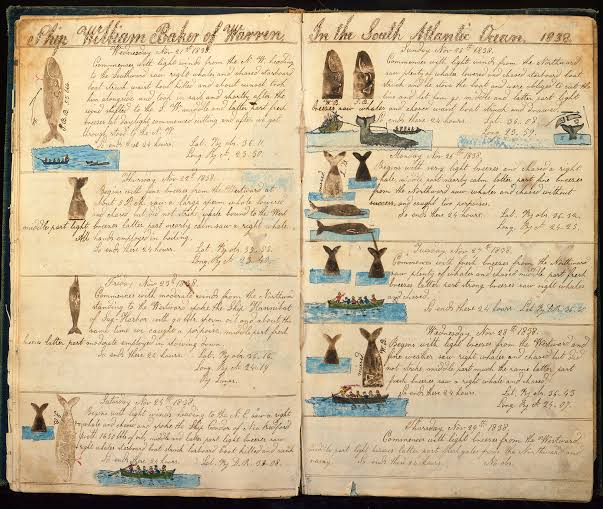
The surviving 1840–42 account book opens a rare window onto the operation. It records the cost of establishing the station, freight between Sydney and Kāpiti, equipment and stores, provisions, and payments to named workers. The record reaches beyond whale catches to the people, trade and credit that sustained a shore-whaling settlement.
The people who made the station work
Headsmen commanded the whaleboats, while pulling hands supplied the power. Tonguers, coopers, carpenters and clerks supported the catching and processing of whales, barrel-making, maintenance and accounts. Thomas Evans is identified as a headsman in 1841. The ledger offers a starting point for reconstructing individual workers and earnings, although that reconstruction has not been completed.
Prickett associates changes in production partly with the movement of experienced crews among stations. The identities and circumstances of particular transfers should not be treated as settled where the records do not establish them.
Three seasons: rise and collapse
In 1840 the five-boat station produced 44 tuns of oil and 57 hundredweight (cwt) of whalebone. In 1841 six boats produced 172 tuns of oil and eight tons of bone. The 1842 return records only seven tuns of oil and seven hundredweight of bone, alongside new headsmen and a changed workforce. The figures describe the reported returns, not necessarily every activity at the station.
The contrast between the 1841 peak and the 1842 contraction shows how quickly the fortunes of a shore-whaling enterprise could change.
Provisions, shipping and wider exchange
Fraser’s separate 1840 trading accounts record £394 spent on pork and £436 on flour. These amounts reveal the scale of provisioning alongside the better-known production of oil and bone. Goods and freight moving to and from Sydney connected the Kāpiti station to a much wider commercial network.
Historical record and interpretation
The principal published discussion is Nigel Prickett, The Archaeology of New Zealand Shore Whaling (2002), Kāpiti chapter, pp. 83–97, particularly p. 86, drawing on the Fraser manuscript and other contemporary records. Whale Song’s Kāpiti – Blood, Oil and Bone also reproduces Fraser trading-account figures. Contemporary returns, later historical interpretation and the surviving account book should be distinguished when reading the story.
Explore connected books
Explore connected history
- Fraser’s Long Point accounts reveal workforce turnover
- A whaling boom and a sudden collapse at Long Point
- Long Point: a workforce and a shifting economy
- Four vessels at Long Point and the loss of John Dunscombe
- Alexander Fraser 1840 station accounts
- The archaeology of New Zealand shore whaling
- 1839 Kāpiti–Mana station grouping
- Kāpiti stations, work and processing
- Kāpiti whaling economics
- Kāpiti archaeological evidence
- Mana and Kāpiti catch figures later published
Follow this history into other books
Continue with these connected accounts. Each opens a separate book with its own evidence and perspective.
Historical context and evidence
Interpreting the three annual returns
The existing Long Point research records 44 tuns of oil and 57 cwt of bone for 1840; 172 tuns of oil and 8 tons of bone for 1841; and 7 tuns of oil and 7 cwt of bone for 1842. These figures describe a particular station account, not the total production of all Kāpiti or Mana stations. A tun and a hundredweight measure different commodities and cannot be added together.
The limits of a surviving account book
An account book can reveal changes in provisions, equipment, labour and production, but it does not automatically supply a complete census of workers or ships. Names may be incomplete, spelling may vary, and accounting dates may differ from the date a whale was taken.
A coast with several kinds of maritime traffic
Whaleboats, coastal traders and larger ocean-going vessels operated in overlapping waters. A ship reported near Long Point was not necessarily owned by the station, and a visiting vessel’s cargo cannot automatically be counted as the station’s catch. The John Dunscombe wreck belongs in the wider maritime context but should not be folded into production totals.
How to read a sudden decline
The fall from the reported 1841 return to 1842 is striking, but the figures alone do not establish its cause. Whale availability, staffing, equipment, seasonality and the completeness of the account could all affect returns.
Reading the Long Point ledger
The extraordinary change across three seasons
The recorded oil output rose from 44 tuns in 1840 to 172 in 1841, then fell to seven in 1842. That is nearly four times the 1840 output in the middle season, followed by a reduction of about 96 per cent. The arithmetic is straightforward; the explanation is not. Without the individual dated ledger entries, these figures cannot tell us whether the change reflects fewer whales, fewer effective crews, different accounting periods or other causes.
Who was paid—and who remains invisible
Headsmen, pulling hands, tonguers, coopers, carpenters and clerks were all part of the operation. Payments in a ledger can illuminate labour relationships, but unpaid family labour, Māori trade, provisioning and informal exchange may be incompletely represented. A payment record is evidence of an account, not a complete portrait of a community.
Following the money beyond the beach
The separately reported 1840 trading expenditures of £394 on pork and £436 on flour together amount to £830. They should not be mistaken for the full cost of running the station. Their significance lies in the scale of provisions and the links among Kāpiti, local suppliers and the Sydney trade network.
A reader’s investigation
Find the original Fraser manuscript entries; transcribe each date, person, payment, commodity and unit; note any balance carried forward; then compare the resulting sequence with vessel arrivals and seasonal catch returns. Keep manuscript figures separate from Prickett’s later analysis and Whale Song’s modern summary.