Kāpiti stations, work and processing
The Trust publication explains six-person whaleboat crews, harpoons and lances. It describes flensing and rendering blubber in cast-iron trypots before oil was stored in barrels. It discusses Māori–Pākehā partnerships and the unequal social and commercial context of shore whaling.
Archaeology and the whaling record
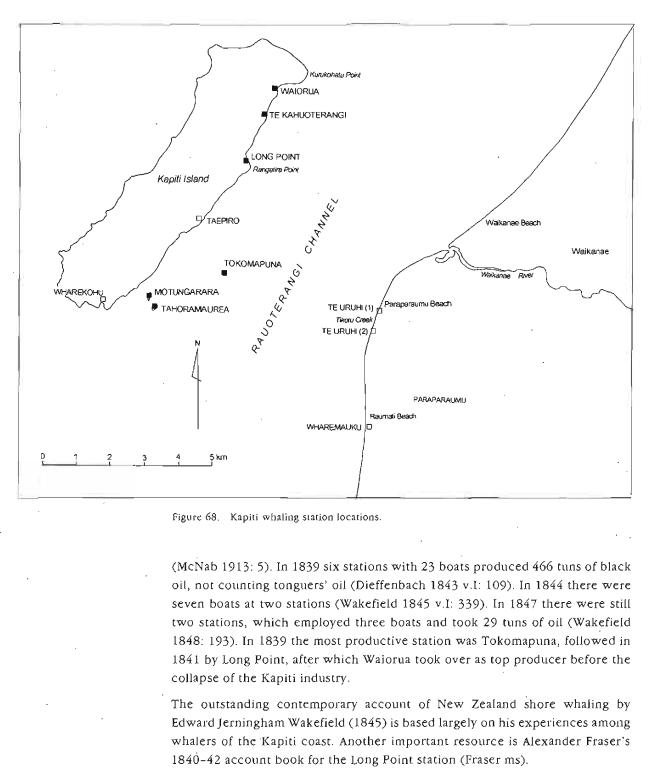
Nigel Prickett’s The Archaeology of New Zealand Shore Whaling (2002) brings together nineteenth-century eyewitness accounts, station ledgers, maps and surviving physical remains. Its Kāpiti section covers stations on Kāpiti and Mana islands and the neighbouring mainland.
At Motungarara, for example, Prickett recorded dry-stone walls beneath coastal vegetation. At Long Point, Alexander Fraser’s 1840–42 accounts illuminate provisions, wages, equipment and shipping costs. Read together, such sources reveal both the physical station and its working economy.
Sources: Nigel Prickett, The Archaeology of New Zealand Shore Whaling (2002), pp. 83–97.
From sighting to oil
At a shore station, a lookout could signal a whale, a crew launched a small boat, and the captured animal was brought back for cutting-in and processing. Trypots and their hearths are among the most durable traces of this industry.
Evidence on the ground
At Te Kahuoterangi, Te Kahuoterangi Simcox recorded about 20 hearths in 1910; Nigel Prickett recorded nine surviving remains in 1982. Prickett describes a two-bay trypot stand with bays approximately 900 and 1,200 millimetres across (2002, Kāpiti chapter).
How an oil return relates to work on shore
Oil production depended on successful boat hunts, towing and landing whales, cutting-in, rendering blubber in tryworks and transferring the finished product for shipment. The archaeological remains of fireplaces and trypots therefore illuminate stages of work that numerical catch returns alone cannot show.
Source: Nigel Prickett, “The Archaeology of New Zealand Shore Whaling” (2002), pp. 83–97.
Explore connected books
Explore connected history
- Six stations, twenty-three boats and the whaling boom
- Wakefield describes whaling boats and island stations
- The archaeology of New Zealand shore whaling
- 1839 whaling scale
- Alexander Fraser 1840 station accounts
- 1839 Kāpiti–Mana station grouping
- Archaeologist Nigel Prickett surveys Kāpiti whaling remains
- Fraser’s Long Point station: an account book opens a lost world