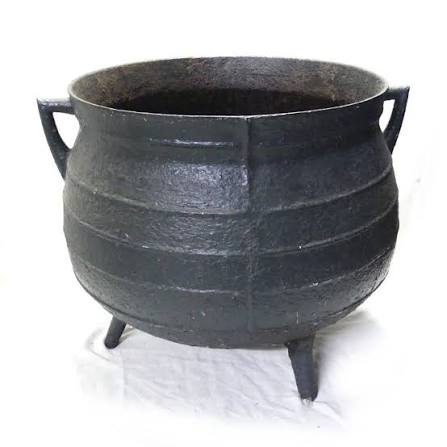
A government report records a surviving try-pot at Waiorua
A 1907 parliamentary report describes Waiorua as an important whaling location from 1836 and says a large try-pot and its stone furnace were still visible at the landing. It also identifies Te Kahu-o-te-rangi as a former whaling station and Māori village. The report is important evidence of physical remains visible in 1907, although its descriptions of Māori history contain period-specific colonial assumptions and require iwi-source comparison.
A surviving try-pot as archaeological evidence
A try-pot is a large iron vessel used to render whale blubber into oil. The archaeological account of Waiorua notes that a try-pot was recorded in January 1972 by members of the Wellington Archaeological Society, before Prickett’s 1982 visit. It is one of the most tangible links between the place and its nineteenth-century industry.
The try-pot must be understood alongside the changing landscape. Prickett describes later farming and holiday accommodation obscuring much of the former station. A single surviving industrial object is therefore not a complete map of the old settlement; J. A. Gilfillan’s 1844 drawing, showing dozens of buildings, provides a complementary record.
Its evidential value is strong for whaling activity at Waiorua, but the object alone cannot identify the person who used it, the year it was installed or the quantity of oil made there.
Source: Nigel Prickett, The Archaeology of New Zealand Shore Whaling (2002), chapter 9, pp. 83–96; see the relevant station section and its cited contemporary records. Interpretations are attributed above.
A try-pot survives at Waiorua
A government report recording a surviving try-pot at Waiorua is material evidence of whale-oil processing at a site where much of the nineteenth-century working landscape has disappeared.
The site’s later importance
Prickett identifies Waiorua as an important station in the later phase of the industry, after Tokomapuna’s prominence in 1839 and Long Point’s in 1841.
Try-pots and the material evidence of whaling
Try-pots were central to shore-whaling work because blubber was heated to produce oil for storage and shipment. The presence of a pot or stone tryworks can provide valuable physical evidence even when a complete station inventory has not survived. Elsewhere in the Kāpiti area, Nigel Prickett recorded a two-bay try-pot stand at Te Kahuoterangi with openings approximately 900 and 1,200 millimetres across. These measurements are evidence about the surviving structure at that site; they should not be transferred to Waiorua without a separate measurement.
Further reading: Nigel Prickett, The Archaeology of New Zealand Shore Whaling (2002), Kāpiti–Mana section, pp. 83–97.
Explore connected books
Explore connected history
- Waiorua: a large working settlement in decline
- Waiorua’s earlier land claim remains ambiguous
- A whaling boom and a sudden collapse at Long Point
- Fraser’s Long Point accounts reveal workforce turnover
- Puketapu ki Paraparaumu — History and Living Connections
- The archaeology of New Zealand shore whaling
- History of Kāpiti Island
- Waikanae: Report on Te Ātiawa/Ngāti Awa Claims
- Kāpiti — Blood, Oil and Bone
- Eleven ships off Kāpiti in 1837