Wharekohu: Mayhew’s landholding is not proof of a whaling station
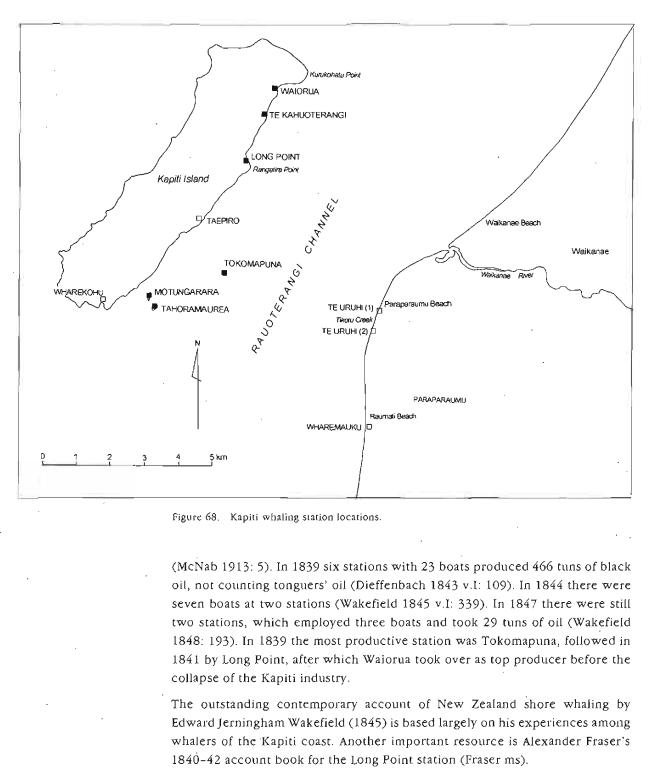
Prickett says there is no archaeological or historical evidence that whaling occurred at Wharekohu, despite later accounts naming a station. Mayhew obtained land there in 1839 and operated a whaling station on nearby Tahoramaurea; Andrew Brown managed a store for Mayhew and later held title confirmed in 1851. The settlement, store and boat evidence must not be turned into a confirmed whaling station.
A landholding is not a tryworks
William Mayhew’s documented associations with land do not automatically establish a whaling station at Wharekohu. A working station requires more specific evidence: contemporary references to boats or oil production, identifiable structures, or archaeological remains that can be connected to whaling. The distinction is particularly important in a coastline where settlements, farms, trading posts and shore stations sometimes occupied neighbouring ground.
A store, a landholding and a nearby station
Wharekohu illustrates the risk of treating every European commercial place as a whaling station. The historical account associates William Mayhew with land acquired in 1839, Andrew Brown with a store, and a later title confirmation in 1851. Mayhew also operated at nearby Tahoramaurea. These are distinct facts, not a chain proving whaling at Wharekohu.
A store could supply whalers without having a tryworks. A whaleboat might land at a place without a permanent whaling establishment. Land ownership does not show where oil was boiled or where crews lived. Prickett’s assessment finds no historical or archaeological evidence confirming whaling at Wharekohu, so the library should classify it as a documented settlement and trade place, not a confirmed station.
Explore connected books
Land, trade and the danger of false certainty
Wharekohu is sometimes included in lists of whaling places, yet Prickett states that he found no archaeological or historical evidence demonstrating a whaling station there. William Mayhew’s association with land at Wharekohu is real historical context, but it does not prove that his whaling operations were carried on at that precise site. His station on nearby Tahoramaurea must not be relocated simply because he also held land elsewhere. Andrew Brown’s store and later property history demonstrate settlement and trade, which may have served the same coastal economy without being whaling works.
A useful research distinction is between the location of a trader’s landholding, the location of a station where whales were processed, and the broader anchorage or beach used by vessels. All three can appear in the same documentary story without occupying the same site. To change Wharekohu’s status would require new evidence such as an unambiguous contemporary station return, a mapped tryworks or securely identified archaeological material. Until then, the public history should say unconfirmed rather than present a conjectural station as established. Source: Prickett (2002), Kāpiti–Mana site assessment; the Mayhew and Brown history is drawn from the existing WhaleLIBRARY account and should be checked against its underlying land records.
Evidence standard: the cited source supports the historical account; unanswered questions are retained rather than filled with speculation.
Explore connected history
- Archaeological research distinguishes confirmed from unconfirmed whaling sites
- Prickett national archaeological inventory
- Six stations, twenty-three boats and the whaling boom
- Tahoramaurea: Te Rauparaha, Mayhew and the whaling settlement
- Early offshore whaling at Kāpiti
- Korohiwa: a drowning, a proposed transfer and Wilson’s crew
- Long Point: a workforce and a shifting economy
- Tokomapuna: Evans’s station and an unresolved date conflict
- Waiorua: a large working settlement in decline
- Taepiro: whaling attribution withdrawn by its original researcher
- Waiorua’s earlier land claim remains ambiguous
- The Archaeology of New Zealand Shore Whaling — Nigel Prickett (2002)