Archaeological research distinguishes confirmed from unconfirmed whaling sites
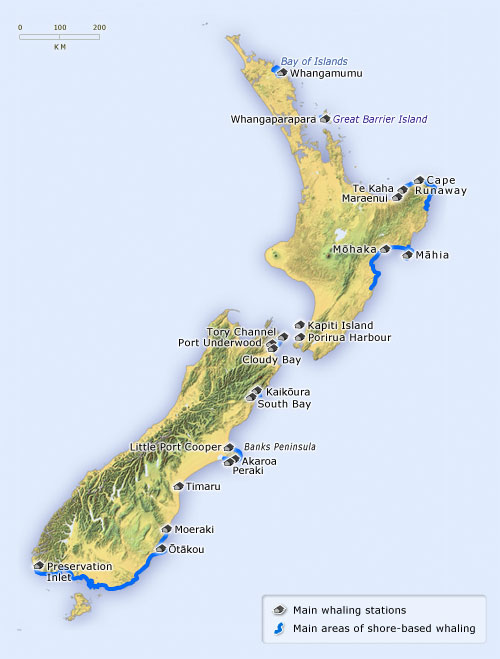
Nigel Prickett’s national shore-whaling survey reports 87 sites with good historical or archaeological evidence and 25 unconfirmed sites. A related summary counts ten sites for the combined Kāpiti, Mana and Palliser Bay region. This regional total must not be represented as ten sites on Kāpiti Island alone. The full report, already held in Whale Song’s research sources, is the next priority for individual station-by-station evidence extraction.
What physical evidence can tell us
The archaeological record is not a simple map of every station mentioned in writing. At Paremata, Prickett found no identifiable whaling remains and noted that later British Army occupation from the 1840s was likely to have disturbed the site. At Motungarara, dry-stone walling survived beneath coastal forest; at Te Kahuoterangi, hearths and a trypot stand remained visible.
These contrasting conditions make historical drawings and documentary records essential partners to archaeology. An illustrated station may have left little visible stonework, while a line of hearths can establish the working character of a site whose workforce has largely disappeared from written records.
Source: Nigel Prickett, The Archaeology of New Zealand Shore Whaling (Department of Conservation, 2002), pp. 87–92. See the full report in the Reports bookshelf.
The difference between a site and an attribution
A land claim, a historic name or a newspaper reference does not always prove that a shore-whaling station stood at a precise location. Prickett’s survey distinguishes documentary suggestions from surviving archaeological evidence.
Two cautionary examples
At Taepiro, an earlier whaling attribution was later withdrawn by its researcher; at Wharekohu, Mayhew’s landholding is not by itself proof of a station. The library retains these leads without converting them into confirmed sites.
Explore connected books
Explore connected history
- Prickett national archaeological inventory
- Six stations, twenty-three boats and the whaling boom
- Wharekohu: Mayhew’s landholding is not proof of a whaling station
- Prickett Kāpiti archaeological reconnaissance
- Te Kāpiti Waewae tradition
- Piopio and Te Kairākau pou
- Whale Song historical whaling-stations map (2023)
- Puketapu ki Paraparaumu — History and Living Connections
- The archaeology of New Zealand shore whaling
- 1839 Kāpiti–Mana station grouping
Follow this history into other books
Continue with these connected accounts. Each opens a separate book with its own evidence and perspective.