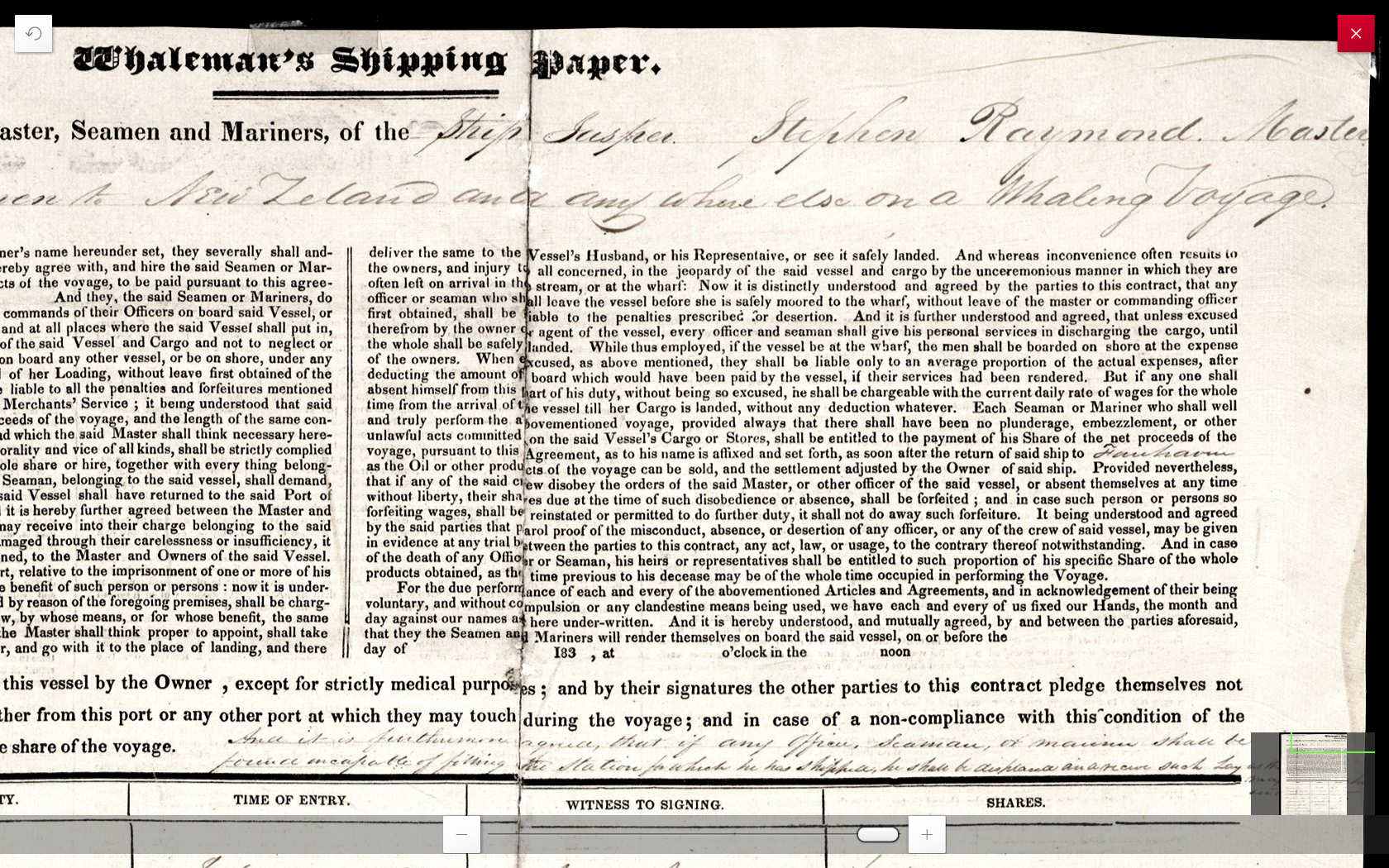
Wellington shipping list shows active whaling traffic
A September 1842 shipping list names vessels arriving from whaling stations or grounds, including the Jane and Lady Mary Pelham, alongside other coastal craft. The entries show the breadth of maritime traffic supporting whaling and trading, but do not establish that every listed vessel visited Kāpiti.
Reading the 1842 shipping entries
The September 1842 shipping notice records vessels moving through Wellington from whaling stations and whaling grounds. Two names retained in the Whale Song research are Jane and Lady Mary Pelham. Their appearance in a shipping list is evidence of the working maritime connections that supported the shore-whaling industry: vessels carried people, supplies and goods between ports, stations and markets.
A shipping list records traffic at the port where it was published. It is not, by itself, a passenger manifest or a register of every anchorage made along the coast. The surviving summary identifies the two vessels above; it does not reproduce the remaining entries, their masters or cargoes. Those particulars belong here when the original September 1842 notice is transcribed.
Reading an 1842 port list as historical evidence
A Wellington shipping list from September 1842 places small coastal craft within a busy maritime network linking whaling settlements, traders and developing colonial ports. Names such as Jane and Lady Mary Pelham are leads to be traced through dated port arrivals and departures, not proof by themselves of any particular voyage to Kāpiti.
The important distinction is between a vessel appearing in a newspaper shipping column and a vessel being independently recorded at a named whaling station. A shipping notice can establish an arrival, departure, master or cargo when those details are printed; it does not automatically identify every intermediate stop.
The original dated issue and its full column are needed to match individual movements accurately. This library preserves the connection to the wider Cook Strait economy without inventing a voyage, captain or cargo not established by the supplied record.
Sources: Nigel Prickett, The Archaeology of New Zealand Shore Whaling (2002), Kāpiti chapter, pp. 83–97 (especially Paremata, Tahoramaurea and Te Kahuoterangi); where specified, Whale Song, Kāpiti – Blood, Oil and Bone (2025). Interpretations and source limitations are distinguished in the text.
A changing fleet and a changing industry
Published station returns offer a frame for interpreting the shipping notices: Kāpiti whaling in 1839 involved six stations and 23 boats, but the returns for 1844 record only two stations and seven boats. By 1847 the two surviving stations employed just three boats.
A shipping notice is a dated observation of a vessel in port, not by itself proof that the vessel hunted whales or owned a station. Read alongside station ledgers and production returns, however, it can reveal how oil, whalebone, equipment and provisions travelled through the wider Cook Strait economy.
Source: Nigel Prickett, The Archaeology of New Zealand Shore Whaling (Department of Conservation, 2002), pp. 83–84. See the full report in the Reports bookshelf.
The port notices as a network map
A Wellington shipping list that includes Jane and Lady Mary Pelham in September 1842 reveals maritime movement at a particular moment. It should not be treated as proof that either vessel hunted at Kāpiti without a matching report.
Why names matter
A ship’s name, master, date and destination can connect scattered newspaper entries into a voyage. The library’s 1837 vessel register offers another example of this method.
What a port list can—and cannot—tell us
Jane and Lady Mary Pelham occur in the September 1842 Wellington shipping intelligence preserved in the library. The notice associates traffic with whaling stations or grounds, but the summary does not establish a Kāpiti landing for either vessel. Recording them as “Kāpiti whalers” would turn a regional maritime connection into a claim the evidence does not support.
Every shipping-list entry should be transcribed with four separate places where available: port of publication, stated origin, intended destination and any intermediate call. The date of the newspaper is not automatically the date a ship arrived or departed. A vessel’s master can change between voyages, and repeated names do not prove a single hull without corroborating registration information.
The September 1842 Wellington shipping list records coastal movements associated with whaling stations and trading grounds. Source: September 1842 Wellington shipping intelligence.
Explore connected books
Explore connected history
- 1837 vessel register and shipping leads
- DOC Wellington Kāpiti heritage
- Fraser brothers remembered in Wellington street-name history
- Te Wai-o-Rongomai and Te Puna-o-Rongomai
- Waikanae naming traditions
- Whale Song, Kāpiti — Blood, Oil and Bone (2025)
- Puketapu ki Paraparaumu — History and Living Connections
- Modern whaling and whale watching
- Kāpiti — Blood, Oil and Bone
- Eleven ships off Kāpiti in 1837
- 1839 Kāpiti–Mana station grouping