Tokomapuna: the physical remains of Tommy Evans’s station
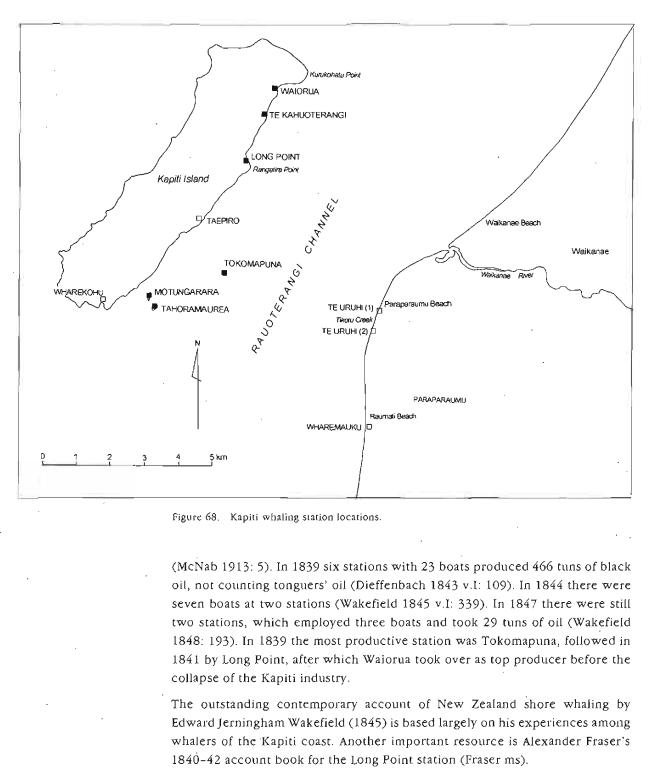
Prickett recorded at least seven stone fireplaces, a boulder mound marking tryworks, terraces and a possible grave at Tokomapuna. Heaphy’s coastal profile identifies Evans’s whaling establishment there. The report links a six-boat station to the exceptionally large 1839 regional whale-oil production reported by Dieffenbach. The archaeological evidence should be mapped separately from the production estimates, which derive from historical reporting.
The surviving evidence at Tokomapuna
The physical arrangement of Tokomapuna explains why a station could operate on such a small island. Prickett describes a low island roughly 175 by 150 metres, with a higher southern point that may have served as a lookout. Its north-eastern beach, sheltered by rocks, provided access for whaleboats; the processing area was immediately behind it.
At least seven stone fireplaces were visible in 1982. Three terraces were identified beside the western ridge. A large mound of stones marked the tryworks, where blubber was rendered into oil. Prickett also noted a possible grave and retaining work along a level area. Each is a different class of evidence: the fireplaces and tryworks are physical observations; the grave remains an interpretation.
The 1839 production figure—approximately half the region’s 466 tuns of black oil from Tokomapuna—makes these remains unusually important. Archaeological features and contemporary production records reinforce one another, but neither alone identifies every worker or establishes the station’s exact opening date.
Source: Nigel Prickett, The Archaeology of New Zealand Shore Whaling (2002), chapter 9, pp. 83–96; see the relevant station section and its cited contemporary records. Interpretations are attributed above.
A productive station with a material footprint
Tokomapuna was described as the most productive Kāpiti-area station in 1839. Its connection with Tommy Evans is important, but station operators and crew members could move between sites, and later recollections do not always agree about dates. Stone remains anchor the station in a real landscape. Comparing those remains with the contemporary figures for boats and oil shows what archaeology can and cannot tell us: the stones demonstrate activity, while the annual returns help date its intensity.
A productive station in its setting
Tokomapuna was the most productive station in the 1839 return according to Prickett’s synthesis. Its physical remains and association with Tommy Evans are different kinds of evidence and should be considered together rather than used as substitutes for one another.
Source: Nigel Prickett, “The Archaeology of New Zealand Shore Whaling” (2002), pp. 83–97.
Explore connected books
Explore connected history
- Tokomapuna: Tommy Evans’s station in stone
- Tokomapuna: Evans’s station and an unresolved date conflict
- Prickett national archaeological inventory
- Six stations, twenty-three boats and the whaling boom
- Fraser’s Long Point station: an account book opens a lost world
- Motungarara: Captain Horse Lewis and Te Hiko
- Tahoramaurea: Te Rauparaha, Mayhew and the whaling settlement
- Te Kahuoterangi: the stone hearths of a vanished station
- The whaling settlement on Motungarara
- Tahoramaurea: two shores, overlapping histories
Follow this history into other books
Continue with these connected accounts. Each opens a separate book with its own evidence and perspective.