Who ran the Tokomapuna station?
Who operated Tokomapuna?
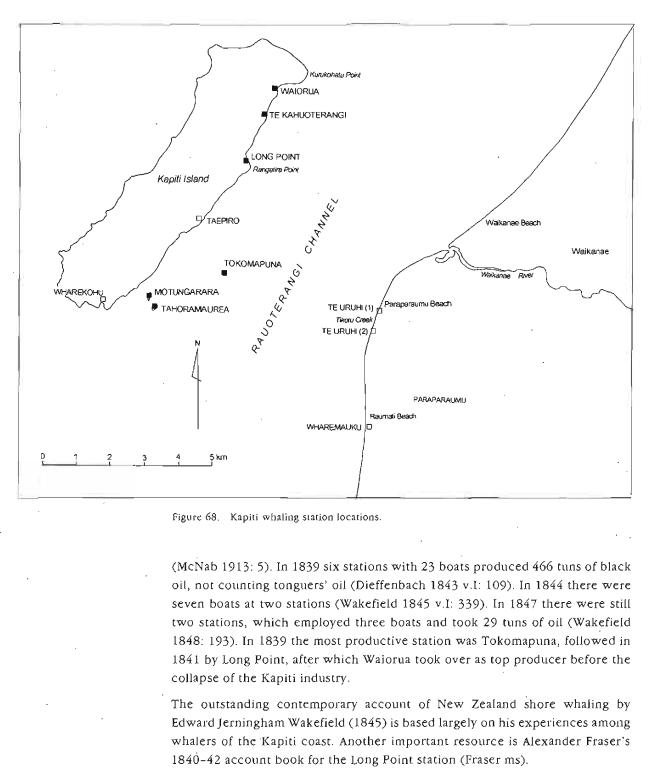
Nigel Prickett associates the Tokomapuna whaling station with Tommy Evans. The connection is strengthened by Charles Heaphy’s 1839–40 coastal drawing, which labels the island as Evans’s English whaling establishment. Prickett does not establish a precise founding date.
The station operated six boats in 1839 and produced about half the black oil reported for the six Kāpiti–Mana stations. Evans may also be the Thomas Evans recorded in Alexander Fraser’s 1841 Long Point accounts, where Prickett describes him as the leading headsman. This identification is explicitly an inference rather than a confirmed biographical match.
The station does not appear in the published 1844–47 station statistics, consistent with operations having ceased earlier. The chronology of its final season is uncertain; the source should not be used to claim a precisely dated closure.
Source: Nigel Prickett, The Archaeology of New Zealand Shore Whaling (2002), chapter 9, pp. 83–96; see the relevant station section and its cited contemporary records. Interpretations are attributed above.
A scholarly study identifies Tommy Evans with the Tokomapuna station, described as particularly productive in 1839.
Evans and the island stations
Thomas “Tommy” Evans is associated with Tokomapuna in accounts of the Kāpiti whaling industry. Tokomapuna was recorded as the most productive station in the Kāpiti–Mana group in 1839. This does not establish that Evans was the sole operator throughout the station’s life: the names of workers, headsmen and proprietors can change between annual returns and later recollections.
An industry measured in boats and oil
The 1839 regional return recorded six establishments, 23 boats and 466 tuns of black oil. Tokomapuna must be understood within this network of neighbouring landing places and mobile crews. Compare the station accounts and archaeological synthesis in Nigel Prickett, The Archaeology of New Zealand Shore Whaling (2002), Kāpiti chapter, pp.83–97.
The station in the wider Kāpiti record
Tokomapuna was described as the most productive station in the Kāpiti–Mana group in 1839. Contemporary accounts put the wider group at six stations and twenty-three boats in that year. A later name attached to a station does not necessarily identify every earlier operator, and whaling parties could shift between landing places as seasons and opportunities changed. The strongest reconstruction therefore draws on dated reports, named operators and archaeological remains together.
Further reading: Nigel Prickett, The Archaeology of New Zealand Shore Whaling (2002), Kāpiti–Mana section, pp. 83–97.
Explore connected books
Explore connected history
Illustrative material from the research image collection