How many whaling stations were operating around Kāpiti in 1839?
The number of operating whaling stations
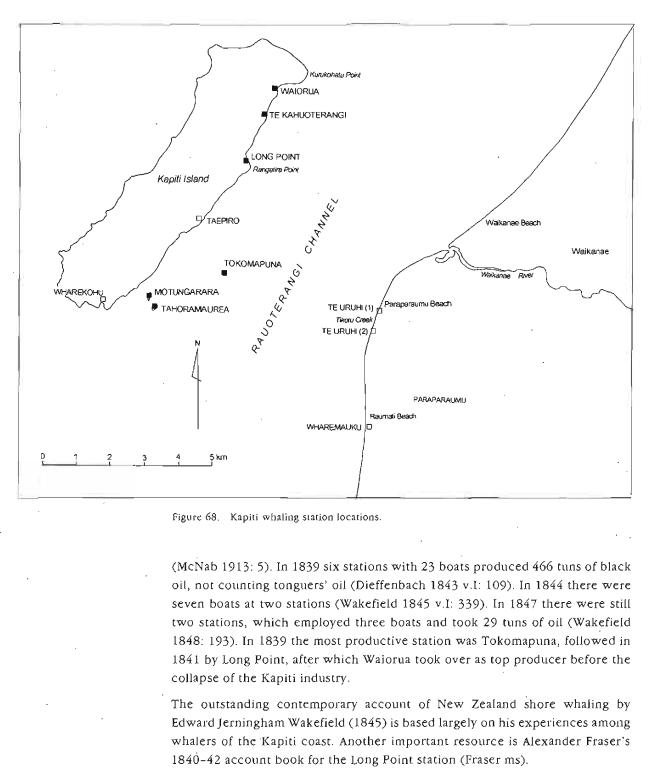
For 1839, Prickett reports six stations and 23 boats in the Kāpiti and Mana region, with 466 tuns of black oil produced, excluding tonguers’ oil. He cites Dieffenbach’s 1843 account for this total. It is a dated production return, not a count of all historical sites.
In 1844, the recorded industry comprised seven boats at two stations. By 1847, two stations with three boats produced 29 tuns of oil. The different figures trace the industry’s decline and should never be combined as though they describe the same year or geographic coverage.
Source: Nigel Prickett, The Archaeology of New Zealand Shore Whaling (2002), chapter 9, pp. 83–96; see the relevant station section and its cited contemporary records. Interpretations are attributed above.
What the archaeological record can establish
The number of stations depends on the year, the geographical area included and whether temporary boat parties count as stations. Nigel Prickett’s regional inventory includes Korohiwa, Long Point, Mana, Motungarara, Paremata, Tahoramaurea, Te Kahuoterangi, Te Kopi, Tokomapuna and Waiorua. This is a survey inventory of documented sites across a region, not evidence that all ten operated simultaneously.
Why historical totals differ
The inventory draws on written accounts, old maps, surviving structures and archaeological surveys. Prickett notes that the beginnings of shore whaling at Kāpiti are particularly difficult to document. Counts from a single year, or from different sources using different definitions, should therefore be kept distinct rather than combined into one definitive figure.
Source
Nigel Prickett, The Archaeology of New Zealand Shore Whaling (2002), chapter 9, Kāpiti, sections 9.1–9.10.
Dieffenbach described six establishments in the wider Kāpiti–Mana island grouping, with 23 boats and 466 tuns of oil. This is not a count of every site ever operating on Kāpiti Island or the mainland.
The six-station figure is a dated return
For 1839, Dieffenbach recorded six whaling establishments around Kāpiti and Mana, with 23 boats, 466 tuns of black oil and 30 tons of whalebone. That is the strongest contemporary numerical snapshot for the year, but the six establishments are not a complete count of all stations that operated before or after 1839.
A changing map of activity
Prickett’s archaeological survey discusses more named places than the six operating establishments in the 1839 return, including Korohiwa, Long Point, Mana, Motungarara, Paremata, Tahoramaurea, Te Kahuoterangi, Tokomapuna and Waiorua. Some stations changed hands, flourished in different years or left only physical traces. The question ‘how many?’ therefore needs a date, a geographical boundary and a definition of a station. Sources: Dieffenbach (1843), vol. I, p.109; Prickett (2002), pp.83–97.
Interpreting the 1839 return
The six-station and 23-boat figure refers to a reported Kāpiti group in 1839; it does not include every vessel at anchor, every independent tonguer, or every shore establishment in Cook Strait.
Source: Nigel Prickett, “The Archaeology of New Zealand Shore Whaling” (2002), pp. 83–97.
Explore connected books
Explore connected history
Illustrative material from the research image collection