How many whaling stations were operating around Kāpiti in 1839?
Reading the station returns
Ernst Dieffenbach recorded six whaling establishments and 23 boats in the Kāpiti–Mana district in 1839, producing 466 tuns of black oil. The figure covers a working district in a particular season; it is not a count of every site ever used around Kāpiti.
The district’s activity contracted during the 1840s. Accounts assembled by Nigel Prickett show two stations and seven boats in 1844, and three boats producing 29 tuns in 1847. Archaeological surveys identify more locations because they cover different periods.
Sources: Ernst Dieffenbach, Travels in New Zealand (1843); Nigel Prickett, The Archaeology of New Zealand Shore Whaling (2002), pp. 83–97.
Six stations in 1839: what the figure means
The six-station figure belongs to the Kāpiti and Mana region in 1839. Prickett cites 23 boats and 466 tuns of black oil, excluding tonguers’ oil, drawing on Dieffenbach’s published contemporary account.
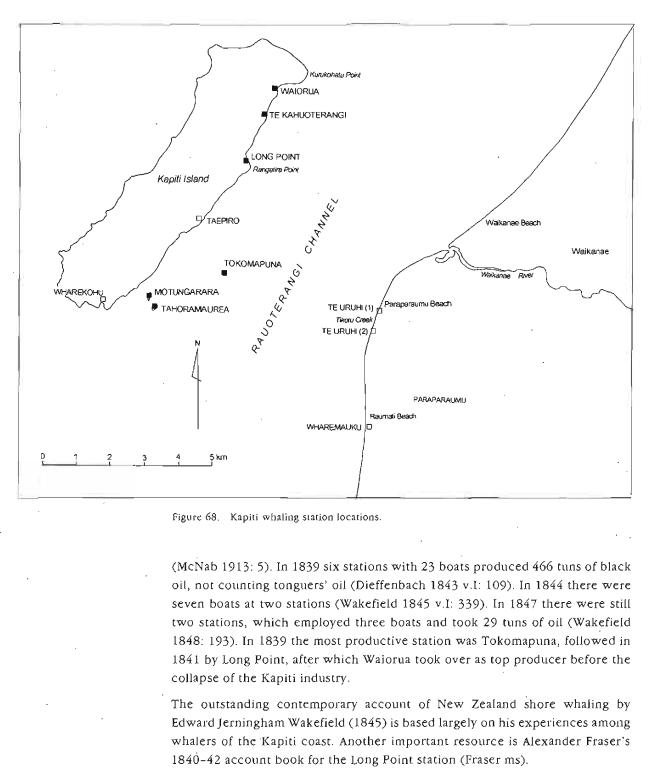
Other figures in the same study describe later seasons: seven boats at two stations in 1844 and three boats at two stations in 1847. A station shown on an archaeological map may have operated in a different year, so the mapped total need not equal the number working in 1839.
Source: Nigel Prickett, The Archaeology of New Zealand Shore Whaling (2002), chapter 9, pp. 83–96; see the relevant station section and its cited contemporary records. Interpretations are attributed above.
Dieffenbach described six establishments in the wider Kāpiti–Mana island grouping, with 23 boats and 466 tuns of oil. This is not a count of every site ever operating on Kāpiti Island or the mainland.
The six-station figure in context
In 1839 the Kāpiti–Mana group was reported as six stations operating 23 boats and producing 466 tuns of black oil, excluding tonguers. By 1844 another report counted seven boats at two stations, and in 1847 three boats at two stations produced 29 tuns. The question “how many?” needs a year attached to it.
The places behind the figures
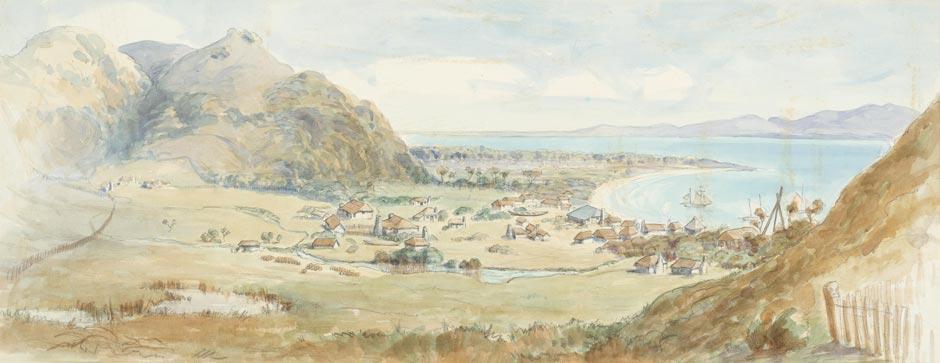
Tokomapuna, Long Point, Waiorua and other named coastal sites appear across documentary and archaeological sources. Prickett (2002), pp.83–97, draws these together, while individual station books describe the physical remains, people and changing output.
The six-station snapshot
The widely repeated count of six stations and 23 boats comes from the 1839 return cited by Dieffenbach and analysed by Prickett. It is a dated observation, not a fixed inventory of all sites ever used.
Source: Nigel Prickett, “The Archaeology of New Zealand Shore Whaling” (2002), pp. 83–97.
Explore connected books
Explore connected history
- A historical map preserves the locations of vanished stations
- Kāpiti stations, work and processing
- Six stations on Whale Song map
- 1839 Kāpiti–Mana station grouping
- Do not conflate station counts
- Six stations, twenty-three boats and the whaling boom
- The Archaeology of New Zealand Shore Whaling — Nigel Prickett (2002)