Do not conflate station counts
Reading the station returns
Ernst Dieffenbach recorded six whaling establishments and 23 boats in the Kāpiti–Mana district in 1839, producing 466 tuns of black oil. The figure covers a working district in a particular season; it is not a count of every site ever used around Kāpiti.
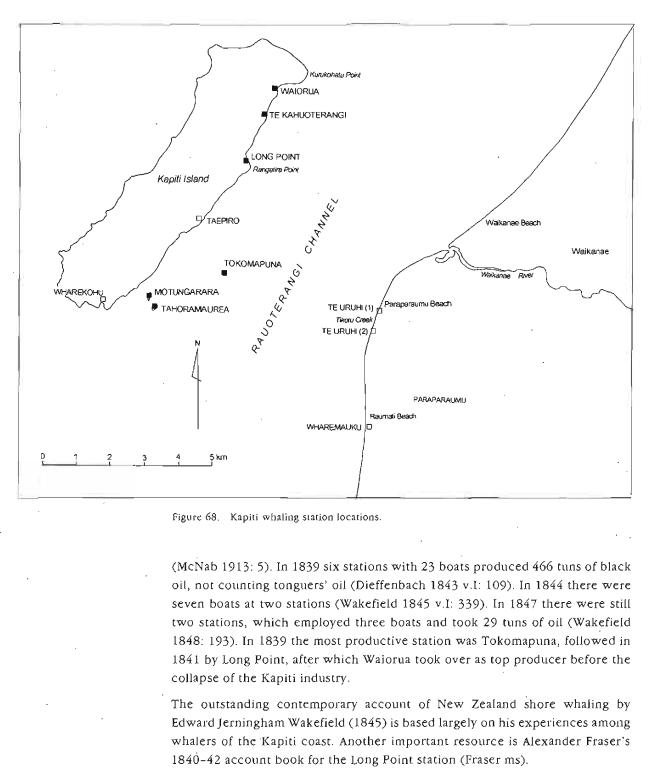
The district’s activity contracted during the 1840s. Accounts assembled by Nigel Prickett show two stations and seven boats in 1844, and three boats producing 29 tuns in 1847. Archaeological surveys identify more locations because they cover different periods.
Sources: Ernst Dieffenbach, Travels in New Zealand (1843); Nigel Prickett, The Archaeology of New Zealand Shore Whaling (2002), pp. 83–97.
Counting stations without combining unlike figures
The 1839 figure of six stations, 23 boats and 466 tuns of black oil refers to the Kāpiti–Mana operating region and excludes tonguers’ oil. Prickett attributes the figures to Dieffenbach (1843). They are not a total for all Cook Strait whaling stations, nor a census of every location that ever held a station.
Prickett gives two operating stations with seven boats for 1844, and two stations with three boats and 29 tuns of oil for 1847. The figures illustrate contraction, but each has its own date and documentary source.
For a historical map, it is useful to show the wider set of documented locations while keeping these dated operating totals separate. The archaeology, newspaper returns and later histories answer related but different questions.
Source: Nigel Prickett, The Archaeology of New Zealand Shore Whaling (2002), chapter 9, pp. 83–96; see the relevant station section and its cited contemporary records. Interpretations are attributed above.
Six 1839 Kāpiti–Mana establishments and other enumerations of sites on Kāpiti Island refer to different geographic and historical scopes; never combine as a single count without defining scope.
Three snapshots, not three inventories
The historical sources report six establishments and 23 boats in 1839; seven boats at two stations in 1844; and two stations with three boats producing 29 tuns of oil in 1847. These figures describe different years and recording practices. They cannot be added together to produce a count of distinct sites.
What archaeology contributes
Physical remains at places such as Te Kahuoterangi, Tokomapuna and Motungarara offer another way to identify historical activity. A stone hearth, a station name in an account and a yearly production return answer different questions; the richest history brings them together rather than forcing them into one number.
Explore connected books
Explore connected history
- A correspondent counts boats and oil at Kāpiti and Mana
- Different station counts
- Wharekohu: Mayhew’s landholding is not proof of a whaling station
- 1839 Kāpiti–Mana station grouping
- How many whaling stations were operating around Kāpiti in 1839?
- Archaeologist Nigel Prickett surveys Kāpiti whaling remains
- Archaeological research distinguishes confirmed from unconfirmed whaling sites